
Auburn-Opelika community, College of Education’s EAGLES Program rally behind film inspired by woman’s extraordinary journey with Down syndrome
AUBURN, Ala. – A film about believing in the potential of those with differing abilities has found the perfect community to champion it. From local investors and businesses to the nationally recognized EAGLES Program in Auburn University’s College of Education, support for the upcoming film ABLE continues to grow across the Auburn-Opelika area.
As October’s Down Syndrome Awareness Month approaches, the project is drawing attention not only for the powerful true story at its center, but also for the partnerships and opportunities it is creating throughout the community. With an anticipated filming start in spring 2027, ABLE has become a collaborative effort that reflects Auburn’s commitment to opening doors, building connections and celebrating the abilities of every individual.
While the film’s story is rooted in Delaware, much of its journey to the screen has unfolded in Auburn.
An Auburn Story Behind the Camera
At the center of that journey is filmmaker Kelly Lintz, whose family’s connection to Auburn spans decades.
Her husband graduated from Auburn University in 1990 with a degree in business, serving as an Interfraternity Council officer and as a member of the War Eagle Girls and Plainsman (WEGP). Over the years, football Saturdays and family visits became a cherished tradition, eventually leading the family to make Auburn their permanent home. The family’s Auburn connection extends beyond one generation. Lintz said her husband passed along his passion for Auburn to their four children, several of whom chose to spend time on the Plains while pursuing careers in the entertainment industry.
“Every time we came here in the fall, the question at the forefront of everyone’s mind was, ‘Could we ever live in Auburn?'” Lintz said. “In May of 2023, we finally made it a reality, and have ZERO regrets.”
For Lintz, ABLE represents a new chapter following a successful career in the entertainment industry. Her credits include recurring roles on Surface, One Tree Hill, Army Wives and Stranger Things, as well as film projects alongside actors including Jennifer Garner, Mel Gibson, Chris Evans and Auburn alumna Octavia Spencer.
Storytelling has become a family affair for the Lintz family. Lintz noted that her children have built successful careers of their own, appearing in productions such as The Walking Dead, Bosch, Bosch: Legacy, The Alienist, Under the Dome and Ms. Marvel, as well as feature films alongside actors including Adam Sandler, Matthew McConaughey and Dakota Fanning.
“My oldest daughter was literally starring on a television series for CBS and came here for one semester in between seasons just so she could experience the Auburn student section at Jordan-Hare,” Lintz said, adding that “My oldest son came here during the COVID year when Hollywood shut down just so he could experience being a member of the Greek community, like his Dad. He would also have to leave to film a series for Marvel Studios, but he still lived here while he shot it in Atlanta.”
For years, the family traveled the world bringing stories to life on screen, and after spending decades telling stories written by others, Lintz felt called to create projects of her own.
“After 35 years as a working actress in film/tv and raising my four children to do the same, I wanted to begin a new chapter of my career, creating film and television projects that produced positive change in the hearts and minds of humanity,” she said. “ABLE is my first attempt.”
Inspired by a Remarkable True Story
The film is inspired by the true story of the Kosmalski family of Middletown, Delaware. When their daughter, Kayla, was born with Down syndrome, her parents made a conscious decision to focus on possibility rather than limitation.
According to Lintz, Kayla went on to earn a spot on her high school’s varsity cheerleading squad, then graduated with honors and received 11 university acceptances and more than $700,000 in scholarship offers. Along the way, Kayla and her family also helped influence legislation benefiting individuals with disabilities.
“ABLE is inspired by the true story of the Kosmalski family of Middletown, Delaware,” Lintz said. “When their daughter Kayla was diagnosed with Down syndrome at birth, they made the decision from the get-go to presume competence and help her redefine what’s possible for someone with a disability.”
Kayla’s accomplishments continued even after the screenplay was completed. In 2024, she became the first teen with Down syndrome to win a state pageant title when she was crowned Miss Delaware Teen USA, further reinforcing the film’s central message about possibility, determination and achievement.
For Lintz, however, the film is about more than celebrating one family’s accomplishments. She hopes ABLE will encourage broader conversations about Down syndrome and provide families with a different perspective on a diagnosis that is too often accompanied by misconceptions and fear.
The filmmakers hope the story will celebrate and encourage families raising children with Down syndrome while helping audiences better understand the opportunities, relationships and achievements that are possible when individuals are supported, empowered and given the chance to thrive.
Auburn-Opelika Embrace the Mission
Although Atlanta was initially the planned filming location for ABLE, the enthusiasm of the Auburn-Opelika community quickly changed the project’s trajectory.
“Our original plan was to go back to Atlanta (where we came from) to film,” Lintz said. “Once this community (Auburn-Opelika) became aware of the project, they jumped in to help get it done in a way that I could not possibly have predicted.”
That support has emerged from every corner of the community. Lintz said hundreds of individuals have donated to crowdfunding, and more than 125 local businesses and just about every civic organization in town have contributed as well.
She said community members have supported the project not only financially but also by volunteering their time and helping spread awareness of the film’s mission.
“It really is true that if you love Auburn, Auburn will love you back,” Lintz said. “To have a place that we have loved so deeply for decades stand beside us to the degree that they have has often caused us to sit in stunned and tearful silence.”
For Lintz, whose family spent years wondering whether Auburn could become home, the answer has been unmistakable.
“We are inexpressibly grateful,” she said. “Our primary goal is to make Auburn proud they have partnered with us.”
EAGLES Takes Flight with the Project
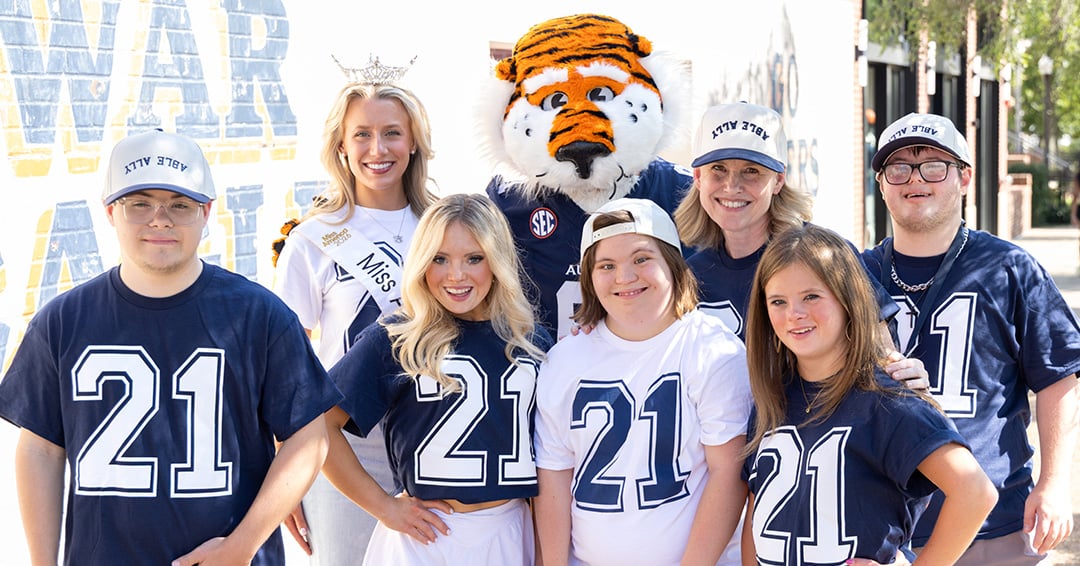
Among the earliest and most enthusiastic supporters was Auburn University’s Education to Accomplish Growth in Life Experiences for Success (EAGLES) Program, housed within the College of Education. The nationally recognized program provides a comprehensive college experience for young adults with intellectual disabilities while helping them develop academic, employment and independent living skills.
According to Lintz, EAGLES played a pivotal role in building awareness and momentum for the project on campus.
“The EAGLES were one of our earliest champions, serving as our on-campus sponsor for a series of visits to various student organizations to spread awareness, an effort that raised $3,000 of our earliest funding from Auburn students!” she said.
Lintz also credited EAGLES Director Betty Patten with helping forge key relationships that proved instrumental to the film’s growth.
“Betty Patten has made some pivotal connections for us, including (initially), to our executive producer, Nick Davis,” she said.
One of those introductions led to a partnership with Davis, chair of the EAGLES Engagement Council, who recently joined the project as executive producer.
“I didn’t fully learn the scope until a meeting with Kelly in mid-July,” Davis said. “And when she shared her vision and her plan to film in the Auburn/Opelika communities, I was immediately committed.”
Shared Values, Shared Vision
Davis said the film’s message and the opportunity to create it in the Auburn area made supporting the project an easy decision.
“That strong alignment with my passion for the EAGLES program and my desire to amplify stories about acceptance, inclusion and respect is why I chose to support the project wholeheartedly as Executive Producer,” he said.
Davis said the project resonates because it reflects the importance of helping individuals reach their full potential and creating pathways to success through support, encouragement and opportunity.
The relationship between ABLE and the College of Education became even more apparent as Davis reflected on the university’s mission and the role EAGLES has played in transforming lives.
“At its core, ABLE is a story about recognizing potential where others may see limitations,” Davis said.
He added that the EAGLES Program reflects many of the same values woven throughout the film’s narrative.
“The EAGLES Program has become a model across Auburn for providing young adults with intellectual disabilities opportunities to pursue higher education, develop independence, build meaningful relationships, and prepare for successful futures,” Davis said. “Those same values are woven throughout the narrative of ABLE.”
Bringing ABLE to Life
The Auburn connection is expected to deepen when the film’s production begins. Several Auburn and Opelika locations have been identified as potential filming sites, and, in recognition of EAGLES Program support, Lintz plans to offer the program’s students an opportunity to participate in the production.
“I plan to repay this gesture by putting as many EAGLES students as possible in this film in one of our pivotal scenes,” she said.
As production plans continue to develop, Lintz is also building an audience for the project. Through social media platforms, a growing mailing list and ongoing community engagement, supporters have been invited to follow the film’s development from its earliest stages through its anticipated release.
Independent films often face challenges without major studio backing. To help address that, the ABLE team has worked to build support throughout the development process through online engagement, community events and grassroots advocacy.
Those interested in supporting the film can follow @ablemovie on Instagram, TikTok and Facebook, subscribe for updates through the film’s website and learn more about volunteer opportunities connected to the production. The filmmakers also hope to complete fundraising efforts ahead of production and continue building support during Down Syndrome Awareness Month in October.
Davis said the widespread support behind the project reflects the very best of Auburn University and the surrounding community.
“The strong local support for this film reflects Auburn University living its land-grant and Auburn Creed values in action,” Davis said.
Lintz and Davis also hope the project sparks meaningful conversations about Down syndrome while encouraging families facing a diagnosis to focus on possibility, hope and opportunity. Through Kayla’s story, ABLE seeks to provide a broader understanding of what can be achieved when individuals are supported, encouraged and empowered.
Lintz said the purpose of the film perfectly aligns with the mission of Auburn University’s College of Education and its EAGLES Program: opening doors and improving lives to build a better future for all.
“The goal of this film is exactly that,” she said. “To improve the lives of people with Down syndrome and the families that raise them with education about the truth of this diagnosis so that they can have a better future.”
- Written by Preston Sparks
###
Auburn University’s College of Education, founded in 1915, offers four academic units and 60 degree options, equipping graduates for a variety of careers as educators, administrators, health professionals, counselors, rehabilitation specialists and more. The college is home to innovative thinkers and doers, working together to meet society’s education and health challenges, building better futures for all.