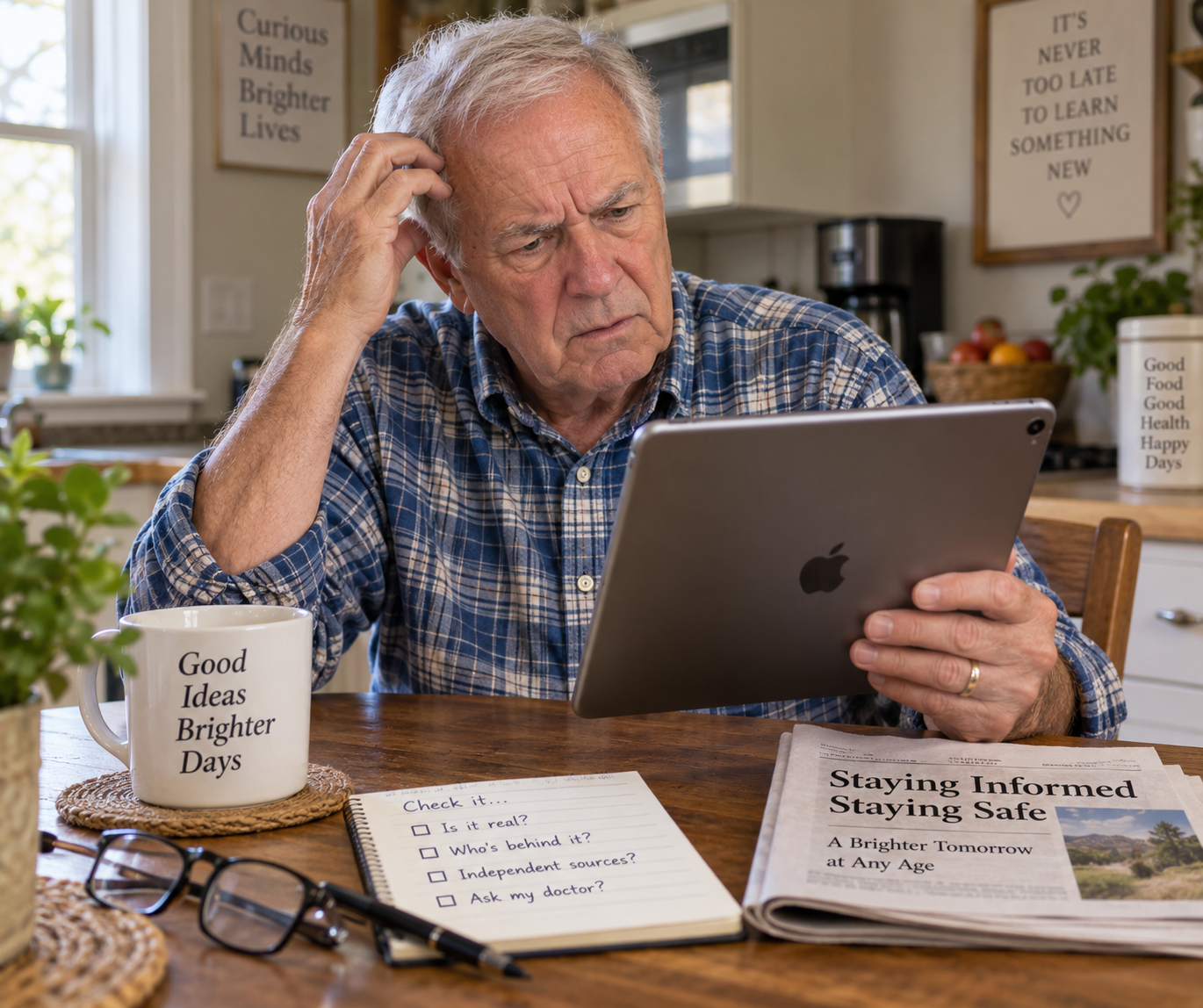

When Seeing Is No Longer Believing
I recently watched a lengthy advertisement that appeared in my Facebook feed. I didn’t buy the product, but I watched the presentation long enough to understand why someone might.
It was convincing.
Elon Musk appeared to be the spokesman. Clint Eastwood appeared in a testimonial. The story involved NASA astronauts, government records, Alzheimer’s disease, microplastics and an alleged discovery that could restore memory in older Americans.
The presentation claimed that Musk’s DOGE investigators had uncovered classified NASA information concerning the health of astronauts. According to the story, researchers had discovered that tiny plastic particles accumulating in the human body could interfere with neurological function and contribute to memory loss and Alzheimer’s disease.
The solution, conveniently, was a nutritional product capable of clearing these obstructions and restoring communication within the brain.
There was even a villain in the story. The pharmaceutical industry supposedly didn’t want you to know about the discovery because an inexpensive treatment threatened billions of dollars in drug sales. And our government classified the research and kept it hidden from the public for more than 50 years.
It was quite a story.
There was just one problem.
I began checking it.
I could find no credible evidence that Elon Musk had anything to do with the product. No credible evidence that Clint Eastwood endorsed it. No evidence that DOGE uncovered classified NASA Alzheimer’s research. No evidence that NASA discovered the advertised cure, and no credible medical evidence that this particular supplement could prevent or cure Alzheimer’s disease.
Apparently, other people had seen versions of the same advertisement and questioned whether the celebrity images and voices were generated by artificial intelligence.
But here is what made the advertisement particularly effective: not everything in it was false.
Scientists really are finding microscopic plastic particles in the human body. Researchers have found microplastics and nanoplastics in human brain tissue. One important study even found greater concentrations in brain samples from people who had suffered from dementia.
NASA really does study the long-term health of astronauts.
Scientists really are investigating environmental factors that might contribute to neurological disease.
Mix those facts together with recognizable people, impressive-looking research, a government conspiracy and an AI-generated celebrity presentation, and fiction can suddenly become remarkably believable.
That should concern every one of us, but particularly senior citizens.
We grew up in a world where seeing someone on television and hearing that person speak provided reasonable assurance that the person actually said those words.
That is no longer true.
Artificial intelligence can now create remarkably convincing video and audio of a famous person appearing to say things that person never said. A familiar face, recognizable voice, television-news setting or famous company logo is no longer proof of authenticity. Don’t blame AI as the villain here. AI is a tool and a good one in the hands of an ethical user. It creates content and images when a user asks it to do that. The villain is the person/entity that used the AI tool to create a very convincing salespitch.
The people creating these advertisements also understand their audience. They know that millions of older Americans worry about memory loss, Alzheimer’s disease, arthritis, diabetes, eyesight, hearing, cancer and other conditions associated with aging.
And they know that hope is a powerful sales tool.
So what should we do?
Before spending money because a celebrity recommends a remarkable new product, stop and investigate.
Search the celebrity’s name together with the product. Look for confirmation from reputable news organizations rather than websites selling the product. If an advertisement claims NASA, the FDA, a university or another respected institution made an important discovery, go to that organization’s legitimate website and see whether it actually says so.
For medical claims, look for evidence from established medical institutions and published scientific research. Ask your physician or pharmacist before taking an unfamiliar supplement, particularly if you already take prescription medications.
And pay attention to the language.
“Doctors don’t want you to know.”
“Big Pharma is hiding this.”
“Government scientists were silenced.”
“This secret discovery was suppressed for years.”
Those statements don’t prove something is fraudulent, but they should immediately cause you to slow down and start asking questions.
Most importantly, never allow the familiar face selling the product to substitute for evidence.
Artificial intelligence is an extraordinary technology. I use it regularly in my own work and believe it will become increasingly valuable.
But every powerful technology can also be misused.
For generations we have advised people not to believe everything they read.
Today we need to add something else:
Don’t believe everything you see or hear, either.
The person looking into the camera may be someone you recognize.
The voice may sound exactly right.
And the person may never have said a word of it.