
AUBURN, Ala. – The recent passing of beloved singer, songwriter and philanthropist Dolly Parton has prompted an outpouring of tributes celebrating not only her musical contributions, but also her lifelong commitment to helping children develop a love of reading. Through Dolly Parton’s Imagination Library, millions of children around the world have received free books during their earliest years. For Auburn University College of Education literacy faculty member Jennie Baumann, the impact of the program extends far beyond the books themselves.
“Dolly Parton’s Imagination Library provides books to any child, regardless of income or situation, up to age five,” Baumann said. “Having books in the house and reading those books aloud supports children’s oral language development, comprehension and vocabulary. The back-and-forth of talk about the text through reading, questioning and interacting with the pictures develops students’ thinking about text from an early age. The ability to talk about and listen to books is the first step in learning how to read – from the act of holding a book and reading left to right, to and through asking and answering questions.”
The Imagination Library mails participating children a new, age-appropriate book each month from birth until age five. According to Baumann, those monthly deliveries create excitement while also encouraging meaningful interactions between children and caregivers.
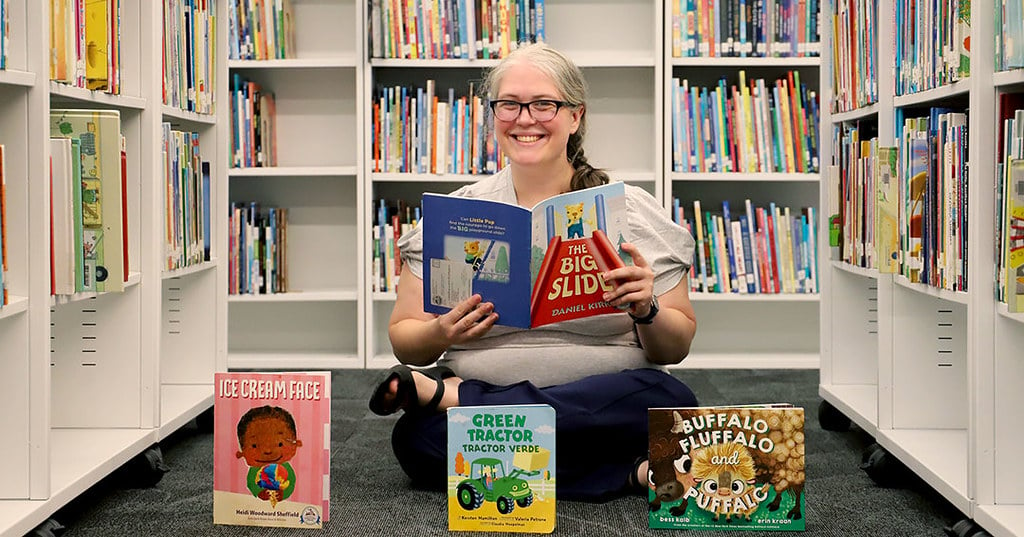
“It’s very motivating to get a new book each month!” Baumann said. “What’s great about the books from the Dolly Parton Imagination Library is that they provide ways to support adult-child interactions with the text. These can be as simple as ‘every time the buffalo takes a nap, make snoring noises’ (from Buffalo Puffalo and Fluffalo), ‘give your child art materials to draw or paint a feelings character of their own’ (A Little Emotional), or ‘look at the cover and read the title aloud. What does your child think the story will be about?’ (The Big Slide). Questions and interactions such as these get children thinking about and interacting with text in a low-risk, high-reward manner. The more they enjoy reading and learning to interact with the text, the more likely they are to become readers later on.”
THE IMPACT OF EARLY READING
Research consistently demonstrates the value of access to books during childhood. Baumann noted that studies have found strong connections between book access and later literacy outcomes.
“Research indicates that the number of books in a child’s home strongly correlates with adult literacy levels, because exposure to language and print provides opportunity for growth from the start.”
Baumann believes one of the Imagination Library’s greatest strengths is its combination of high-quality books and built-in guidance for families.
“For me, what is most notable is that families are provided with free books and the dialogic resources to support reading at home,” Baumann said. “Books from the Dolly Parton Imagination Library have questions and rich vocabulary that naturally spark oral language. The books themselves are high-interest (at least according to my two-year-old and six-month-old), which increases the re-read-ability factor. Repeated reading of books supports fluency, prosody (reading expression), and meaning-making — all of which can be observed through talk.”
The program’s approach closely aligns with research-based literacy practices emphasized in Auburn’s teacher education programs.
“Children need exposure to texts and talk early and often,” Baumann said. “They learn about concepts of print and book handling, which supports them in learning how to get ready to read. The books are also highly connected to children’s experiences on a socioemotional level, but also through ‘mirrors, windows, and sliding glass doors’ (Bishop, 1990). Children need to be able to see themselves represented in text (mirrors), but also learn about others (windows), and how to transact between those ways of being (sliding glass doors). The books provided by the Dolly Parton Imagination Library can be found in all three categories.”
RICH LANGUAGE EXPERIENCES
Baumann also encourages parents and caregivers to embrace rich language experiences when reading with young children.
“Use ‘big words’ with them as you read — rich vocabulary usage matters!” she said. “If you put them in context, explain them, and connect them to lived experiences, you increase their oral language and comprehension. What I say with our 3010 students is that, if a kid can say Tyrannosaurus Rex and understand what it is, they can understand and use words like ‘pollinate,’ ‘ominous,’ and ‘adventure.'”
Beyond individual literacy gains, Baumann sees programs like the Imagination Library as investments in stronger communities.
“Literacy is all around us. We engage with texts, which can be anything ‘read, said or done’ (Sedita, n.d.), in some form every single day,” Baumann said. “Learning to read and access books that come to your doorstep increase engagement but also can shape who children grow up to be. If we want thinkers and problem solvers, we need to put the tools they need in their hands. It starts and ends with literacy.”
As educators, parents and literacy advocates reflect on Parton’s legacy, Baumann believes the first book many children receive through the program offers a fitting reminder of the impact one person can have.
“It seems fitting that the first book in a child’s Imagination Library journey is The Little Engine That Could, a story built around four simple words: ‘I think I can.’ In many ways, those words could serve as a refrain for Dolly Parton’s own life. The girl who dreamed of making music grew into an artist, storyteller, and philanthropist who has put millions of books into the hands of children. And now, through the Imagination Library, her legacy lives on in a new generation of little engines—children turning pages, discovering stories, building literacy, and beginning to imagine all that they, too, might do. Thank you, Dolly, for believing you could so we could too.”
###
Auburn University’s College of Education, founded in 1915, offers four academic units and 60 degree options, equipping graduates for a variety of careers as educators, administrators, health professionals, counselors, rehabilitation specialists and more. The college is home to innovative thinkers and doers, working together to meet society’s education and health challenges, building better futures for all.