
The Roller Coaster at the Pump
Why gasoline prices in America swing so dramatically
Reported by Mike Hobson
March 20, 2026
Few economic signals are as visible to the American public as the price of gasoline. Unlike the price of bread or electricity, gasoline prices are posted in giant numerals on roadside signs in every community. The result is that when the price rises or falls sharply, the change becomes an immediate political and economic story.
Over the past five years Americans have experienced some of the most dramatic gasoline price swings in decades. Prices plunged during the COVID-19 pandemic in 2020, surged to record levels in 2022 after geopolitical disruptions, moderated in 2023–2025, and then rose again during renewed tensions in the Persian Gulf in 2026. These fluctuations reflect a complex interaction of global oil markets, domestic production, refining capacity, and geopolitical risk.
Understanding the volatility requires answering several key questions.
- What caused the wide gasoline price swings over the last five years?
Several factors have driven gasoline price volatility since 2020.
Pandemic collapse and rebound
In 2020, worldwide travel collapsed during COVID-19 lockdowns. Demand for fuel plummeted, causing oil prices to fall dramatically and pushing gasoline prices down as well. When economic activity resumed in 2021 and 2022, demand rebounded faster than production capacity, sending prices sharply upward.
Global supply disruptions
Major geopolitical events also affect oil markets. For example, tensions or conflict in the Middle East can trigger rapid increases in oil prices. In early 2026, for instance, escalation involving Iran pushed crude oil prices above $100 per barrel, contributing to a sudden rise in gasoline prices across the United States.
Seasonal demand and regulations
Gasoline prices also follow seasonal patterns. Refiners switch to a more expensive summer fuel blend to meet environmental standards, while travel demand peaks during summer vacation months. Both factors tend to push prices higher each spring.
Refining and distribution constraints
Unlike crude oil, gasoline cannot easily be shipped globally without refining. If a refinery shuts down or experiences maintenance problems, local gasoline prices can spike even when crude oil prices remain stable.
Financial markets
Oil is traded globally on commodity exchanges. Expectations about future supply disruptions—sometimes triggered by political events or speculation—can move prices within hours.
The key point is that gasoline prices reflect a global commodity market, not just domestic supply conditions.
- How much OPEC or Persian Gulf oil does the United States import?
Contrary to common belief, the United States imports relatively little oil directly from the Persian Gulf today.
Only about 8–9% of U.S. petroleum imports originate from Persian Gulf countries, a dramatic decline from decades past.
This change reflects the American shale oil boom that began in the late 2000s. Hydraulic fracturing and horizontal drilling expanded domestic production, making the United States the world’s largest oil producer.
OPEC’s share of U.S. imports has also declined sharply. In the late 1970s, OPEC supplied about 85% of imported oil to the United States. Today the majority of imports come from North America.
Despite this reduced dependence, global oil prices remain interconnected. Even if the U.S. imports little Middle Eastern oil directly, disruptions there still affect the worldwide price of crude.
- Why can a Persian Gulf disruption trigger U.S. price spikes within 24 hours?
This phenomenon surprises many consumers.
If only a small portion of U.S. oil comes from the Persian Gulf, why do conflicts there immediately raise prices at American gas stations?
The answer lies in the global nature of oil markets.
Oil is traded internationally in a single interconnected market. Events affecting supply anywhere influence the worldwide benchmark prices—primarily Brent and West Texas Intermediate (WTI). Once those benchmark prices rise, refineries and wholesalers in the United States pay more for crude oil regardless of its origin.
A critical geographic choke point is the Strait of Hormuz, through which about 20% of the world’s oil supply passes. When shipping through this channel is threatened or interrupted, global supply expectations change instantly.
Because oil futures markets operate around the clock, prices can adjust almost immediately after such news breaks. Retail gasoline prices then follow rapidly because stations must replenish inventory at higher wholesale prices.
In short, American gasoline prices are determined by the world oil price, not just domestic supply.
- How much crude oil does the United States import and from where?
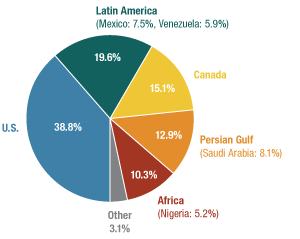
The United States remains both a major importer and exporter of petroleum.
The country imports several million barrels of crude oil per day, but the sources are heavily concentrated in nearby countries.
The leading suppliers include:
| Source country | Share of U.S. crude imports |
| Canada | ~60% |
| Mexico | ~10% |
| Saudi Arabia | ~7% |
| Iraq | ~4% |
| Colombia | ~4% |
Overall, imports account for a relatively small share of total U.S. energy supply—about 17% in 2024, the lowest level in nearly forty years.
Several factors explain why the U.S. still imports oil despite producing large quantities domestically:
- Refinery configuration: Many U.S. refineries are optimized for heavier crude oils that come from Canada or Latin America.
- Regional logistics: It can sometimes be cheaper for coastal refineries to import oil than to transport domestic crude from inland shale fields.
- Trade economics: The United States also exports large amounts of crude and refined petroleum products, creating a two-way trade.
- What have major oil companies earned during this period?
The past five years have been extremely profitable for major oil companies.
Following the pandemic downturn in 2020, profits surged as oil prices rebounded. Companies such as ExxonMobil, Chevron, Shell, and BP reported some of the largest earnings in their history during 2022–2023.
Industry profits fluctuate with oil prices. When crude oil approaches or exceeds $100 per barrel, energy companies typically generate large margins. When oil prices fall below $60, profits decline sharply.
For example:
- Several major oil companies posted record annual profits in 2022, driven by high global oil prices.
- Earnings moderated in 2023–2025 as oil prices stabilized.
- Renewed geopolitical tensions in 2026 have again pushed prices upward.
Supporters of the industry argue these profits reflect the enormous capital investments required to explore and produce oil. Critics contend the profits demonstrate the market power of large oil firms during supply disruptions.
Regardless of perspective, the financial performance of oil companies closely tracks global oil prices.
It remains to be seen what effect the current war in Iran will do for/to earnings for the major oil companies in 2026. Price increases at the pump have been dramatically higher in the last week in the U.S.
- Visualizing the gasoline price cycle
Approximate U.S. average gasoline prices (2020-2026)
| Year | Average price per gallon |
| 2020 | ~$2.17 |
| 2021 | ~$3.01 |
| 2022 | ~$3.96 |
| 2023 | ~$3.53 |
| 2024 | ~$3.50 |
| 2025 | ~$3.10 |
| 2026 forecast | ~$2.97 |
Forecasts suggest the national average could fall below $3 per gallon in 2026 if geopolitical disruptions remain limited.
Local reality (Bibb County, Alabama) has seen pump prices already approaching $3.50 per gallon this week.
Major drivers of pump prices
Typical components of the gasoline price:
| Component | Share of pump price |
| Crude oil cost | ~50–60% |
| Refining | ~15–20% |
| Distribution & marketing | ~10–15% |
| Taxes | ~10–15% |
Because crude oil accounts for roughly half of the retail price, changes in global oil markets quickly influence gasoline costs.
Conclusion: The global nature of gasoline prices
The volatility of gasoline prices over the last five years illustrates a simple reality: the American pump is connected to the global energy system.
Even though the United States now produces more oil than any other country and imports far less from the Middle East than in the past, domestic gasoline prices remain sensitive to global events. Political conflict in the Persian Gulf, refinery outages, seasonal demand, and financial speculation can all ripple through international oil markets and reach American drivers within days—or sometimes hours.
The modern oil market is therefore less about geography than about interconnected supply chains and global pricing mechanisms. Until transportation moves away from petroleum as its dominant fuel, the price displayed on gas station signs will continue to reflect events occurring far beyond America’s borders.